A RECORD OF LUBIS EDA

#1 WHAT’S THE NEWS? – KEEP UP TO DATE!
August 29, 2022Why formal verification is important for semiconductor development
June 15, 2023
Thank you very much for tuning into our first blogpost!
To explain the origin story of LUBIS EDA`s, we need to take a small trip back to 2015. It all started, when I was reading a fellow PhD’s work on Path-Predicate Abstractions (PPA), looking for inspiration for my own research.
The work of my college was focusing on establishing a sound abstraction of an existing RTL design by using formal properties. At that time, he was working on the idea of using the abstract model as a starting point for a top-down hardware design flow (ESL to RTL). In parallel I was supervising a software programing project that focused on teaching Test-Driven Development (TDD).
Suddenly, it dawned me: Why not combine the principles of TDD with his research? We called it Property-Driven Development (PDD). Similar to TDD, the goal is to have the properties prior to implementing a design. This serves as a guideline, a basis of ‘truth’, for the designer and forms the basis of our first product idea LUBIS Veritas.
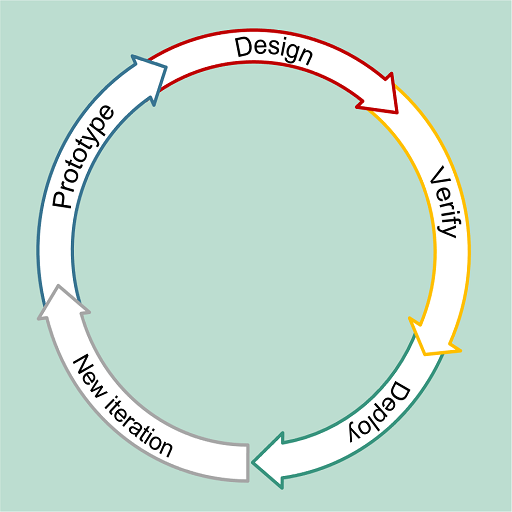
Fast forward to today. We came together as a team. We continue to apply agile ideas to hardware development, leading to completely new types of products. LUBIS EDA products lead to a faster time-to-market, less development costs and correct-by-construction RTL designs.
Our vision is to become the first EDA company that provides the tools required for a true shift from waterfall to an Agile Hardware Development.